
Pasapalli Sarees
Odisha ikat silk saris have fine count silk yarns, normally metallic finish and dyed to perfection. The indigenously procured silk yarns are best suited for these saris and have an excellent finish.
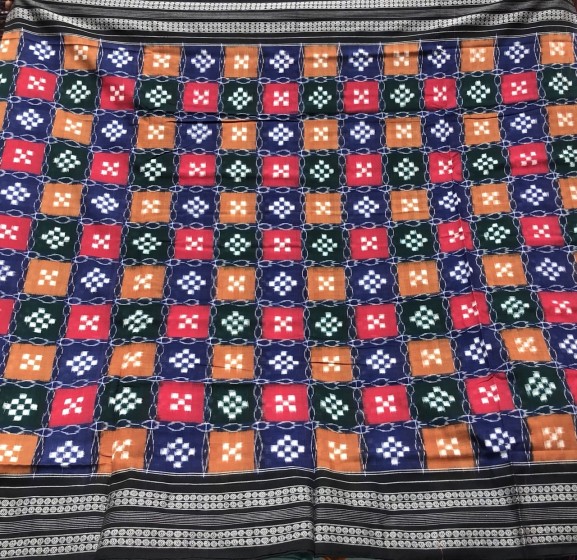
The specialty of the sari is, it has chess board like prints in the entire body with characteristic white and black/red squares. The sari is normally made from cotton, tassar, silk and silk and tassar combined. The sari is given additional face-lift with the golden coloured threads. The thread makes the sari look more fabulous. The borders of this sari are usually decorative and the `aanchal` is designed in various patterns. The excellence of this weaving is accredited to the ancient weaving art form called `baandhakala`. This is a very intricate method and done manually with great caution. The `baandha` is performed by tie-dye method which is unique in itself. To create this, yarns are rolled and tied in distinctive style so that certain portion of the yarn is prevented from absorbing dyes. This facilitates the weaver to have the motif on both the side of the Pasapalli sari alike. This baandha technique enables the weaver to weave the sari in different patterns, colors and multiple designs. With this technique the weavers weave the images like the flowers, landscapes, geometrical patterns and several other designs which are made to order. The baandha is carried out with an initial conceived idea and then such conceived pattern are inducted in the yarn roll, thus facilitating which place to dye and the place to prevent from dyeing. The aanchal of Pasapalli sari has peculiar traditional designs woven in the sari like sankha (conch), chakra (wheel), phulla (flowers), animals, birds and at times temple like imprint. This portrays the artistic level of the weavers and their craftsmanship. The entire weaving method of the Pasapalli sari runs through an intricate procedural technique.
The efforts of Government of India and Government of Odisha along with their associated bodies have geared up from the 1980`s to market the traditional hand-woven saris in the national and international field. Wherever, Odisha`s traditionally weaved sari has been exhibited, it has drawn very encouraging responses and many times has been awarded nationally and internationally.
Some Similar Sarees

Exclusively woven traditional Ikat motifs traditional sambalpuri Nabakothi Silk saree with blouse
₹30000 ( USD 365.85 )

Exclusively woven mustard golden dual tone double Aanchal Berhampuri silk saree with blouse piece
₹23000 ( USD 280.49 )

Exclusively woven heavy thread work on front n pallu Ganjam Bomkai Saree with blouse piece
₹27000 ( USD 329.27 )

Exclusively woven fish motifs zari work double Aanchal Berhampuri silk saree with blouse piece
₹25000 ( USD 304.88 )

Beautiful cotton dolabedi saree with blouse piece
₹11000 ( USD 134.15 )

Beautiful Rust Dongria inspired Silk saree with full work blouse
₹19000 ( USD 231.71 )

Nature inspired animal and bird motifs Bomkai Silk Saree with blouse piece
₹29000 ( USD 353.66 )

Traditional fish and turtle butas Sambalpuri Cotton Saree with blouse piece
₹8000 ( USD 97.56 )

Beautiful Red and Blue combination cotton Ikat saree with blouse piece
₹8000 ( USD 97.56 )

National award winning weaver s dusphulia thick border with Ikat motifs Aanchal Cotton saree
₹21000 ( USD 256.1 )

Beautiful cotton Ashwini saree with temple motifs Aanchal
₹11000 ( USD 134.15 )

Master weaver s creation Kanchi abhijan theme natural dyed Ikat silk saree with blouse piece
₹52000 ( USD 634.15 )